
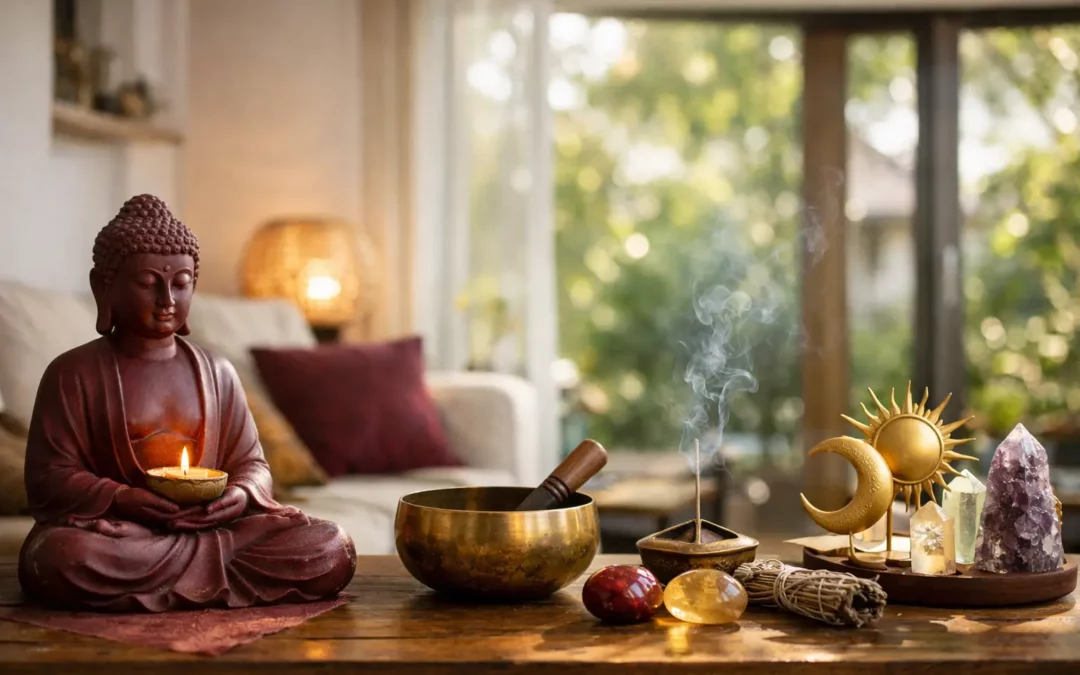
Sometimes it’s not you who’s tired. Sometimes your home carries a weariness you feel in your body before you can explain it in words. If you walk through the door and feel tension, agitation, heaviness, or lack of direction, it’s possible that an energetic harmonization of the home is exactly the intervention you need—not as a decorative gesture, but as a real recalibration of the space you live in.
The home is not just the place where you sleep, eat, and organize your belongings. It’s a living field that either supports or erodes your inner state. It gathers the rhythms of the family, unspoken emotions, habits, old conflicts, periods of stagnation, and the intentions you have for the next stage of life. That’s why, when the space is burdened, clarity no longer flows naturally.
What energetic harmonization of the home actually means
Energetic harmonization of the home doesn’t just mean airing out, ambient fragrance, and a few beautiful objects strategically placed. These can support the atmosphere, but they don’t always address the cause. Essentially, we’re talking about the process through which you observe how energy circulates in a space, what blocks it, and how you can restore a state of coherence between home, body, and your life direction.
A harmonized space is not necessarily perfect, minimalist, or spectacular. It’s a space where you feel gathered, supported, and more present. It helps you sleep better, think more clearly, have smoother relationships, and maintain a healthy life rhythm more easily. And when the home works with you, not against you, many things begin to move without force.
Signs that your home needs energetic harmonization
Some signs are obvious, others very subtle. You may feel that, even though you constantly tidy up, the space remains heavy. You may notice unexplained fatigue, insomnia, frequent irritation, or repetitive conflicts among family members. Other times, financial stagnation, lack of focus, chronic procrastination, or the feeling that nothing connects appear.
There’s also the silent signal: the home looks good, but it doesn’t nourish you. You feel like a stranger in your own space. You don’t rest deeply, it doesn’t inspire you, it doesn’t call you toward your clearer and more settled version. Here appears the difference between aesthetic and energetic. You can have a beautiful interior, but without real support for the life stage you’re in.
When the space takes on your personal history
The home reflects much more than your taste. It also reflects your emotional story. If you’ve gone through losses, separations, long periods of survival, or family tensions, these layers can remain visible in the way you keep objects, occupy rooms, or avoid certain areas of the house.
Often, harmonization begins when you recognize that the space is not neutral. It amplifies what you’re already experiencing. That’s why a burdened home can maintain a blockage, and a cleared and rearranged home can support changes you’re already working on internally.
Why superficial solutions don’t work
There’s a temptation to look for quick fixes. You move furniture, light sage, buy crystals, change curtains, and hope the atmosphere transforms immediately. Sometimes it helps, but not always enough. If the problem is deep, the intervention needs to be coherent.
A ritual done mechanically doesn’t bring clarity if the home is suffocated by accumulations, if important areas are neglected, or if the space remains in contradiction with your real needs. Likewise, technical consultation doesn’t produce lasting results if you ignore the emotional component of your connection with the home. This isn’t just about arrangement, but about alignment.
How to approach energetic harmonization of the home maturely
The first step is observation. Don’t start from the idea that something is wrong, but from the question: what is this space communicating to me about myself now? Enter each room and feel it. Where do you breathe easily and where do you contract? Where does clutter always gather? What corners do you avoid? What objects consume your energy instead of nourishing it?
The second step is release. You can’t invite new energy into a space that still holds the past captive. Release doesn’t just mean throwing things away, but discerning what supports the current stage and what keeps you tied to an old identity. There are objects received out of obligation, furniture kept out of guilt, clothes that speak about who you were, not about who you’re becoming.
The third step is conscious order. Not every organization produces balance. Authentic order has an energetic logic: flow, functionality, breathing space, clear centers, well-differentiated active areas and rest areas. When everything is cramped or chaotic, the mind remains on alert. When the space breathes, you too begin to gather yourself.
The role of intention in the process
After clearing and rearranging, intention becomes essential. A harmonized home is not based only on elimination, but also on direction. What do you want this space to support for you? Healing, rest, prosperity, warmer relationships, creativity, motherhood, professional expansion?
Without this clarity, even a beautiful space can remain neutral. With intention, each room gains meaning. The bedroom is no longer just the place where you collapse exhausted at the end of the day, but a space of restoration. The work area is no longer the corner where you force yourself, but a place that helps you create with focus and coherence.
What matters most in each area of the home
The entrance is the first energetic filter. If there’s chaos here, abandoned objects, burden, or lack of light, energy enters fragmented. A clear and cared-for entrance conveys stability and openness. It doesn’t have to be large, just consciously organized.
The bedroom requires gentleness, protection, and simplicity. Too many screens, too many objects, aggressive colors, or things stored under the bed can subtly agitate your nervous system. If sleep is disturbed or the couple relationship is tense, this is where it’s worth truly looking.
The kitchen speaks about nourishment and abundance. When it’s neglected, cold, or suffocated, the relationship with your own resources can become unbalanced. And the work space directly influences the capacity for concentration, decision-making, and concrete manifestation.
Not all homes require the same adjustments. Here the mature part of the process comes in: understanding that harmonization is not done according to rigid rules, but according to context. The configuration of the home, your life stage, and family dynamics change the right solution.
Between spiritual and practical: why you need both
There are people who work deeply with themselves, but live in a space that daily sabotages their balance. And there are people who organize their home impeccably, but remain emotionally blocked. True transformation happens when the two planes meet.
Feng Shui, for example, can bring a clear map of the flow and energetic quality of the space. But the results are stronger when they’re also supported by inner work: releasing family loyalties, clarifying real desires, recalibrating beliefs about safety, love, and prosperity. When the person, the lineage, and the space realign in the same direction, change gains consistency.
That’s why sometimes a simple rearrangement of objects is not enough, and other times it produces surprising effects. What matters is what supports that intervention in the substrate. An external adjustment made at the right moment can open an important inner process. And conversely, an inner transformation often needs a home that can receive it.