
Family Constellations and transgenerational trauma
Discover how transgenerational trauma, family loyalties, and family history can influence your life. Explore these patterns through Family Constellations.
Online 1 to 1
100€
2.5 hours
Signs that transgenerational trauma still influences you
You feel like you carry emotions that don’t belong to you
You have states of anxiety, sadness, or guilt without always understanding where they come from.
You repeat the same patterns in the family
You notice that certain conflicts, relationships, or difficulties appear from generation to generation.
It is hard for you to feel free
You have the feeling that you must follow a path that is not truly yours.
You feel an unexplained guilt
You feel responsible for others or find it hard to choose what is best for you.
You carry fears that you don’t understand
The fear of abandonment, failure, deprivation, or loss seems disproportionate to your personal experiences.
Family history is full of silences
There are people who are not spoken about, hidden events, or subjects considered taboo.
You have the feeling that you are repeating someone else’s destiny
It’s as if you are living a life that doesn’t entirely belong to you.
You struggle to find your place
Even though you make many changes, something seems to hold you back.
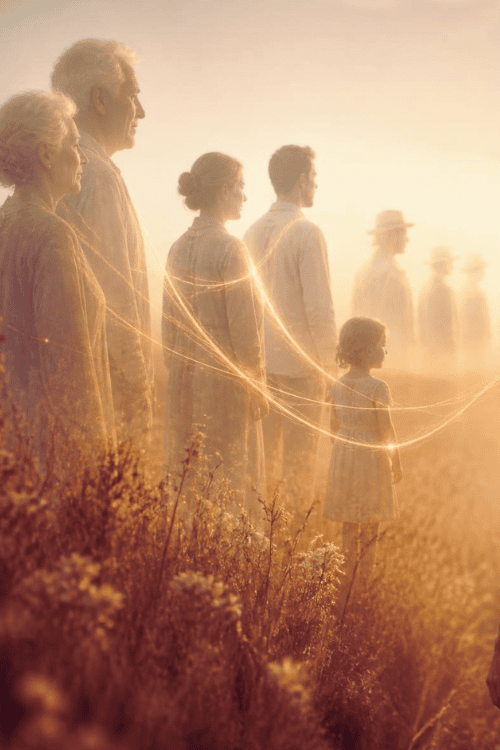
How can transgenerational trauma be explored through Family Constellations?
Every family transmits more than physical traits or stories. Values, beliefs, relationships, and the way difficult events are lived can influence future generations.
Sometimes, losses, wars, migrations, divorces, illnesses, exclusions, or other landmark experiences can leave traces that continue to be felt, even by those who did not directly live those events.
Family Constellations offer a space where these dynamics can be explored from a systemic perspective, without judgment. The goal is not to find a culprit, but to understand how family history can influence the present and how each person can occupy their own place in the system.
In individual sessions with objects, we use symbolic representations to explore family loyalties, unconscious patterns, exclusions, and important events in family history. This process can bring more clarity and can support the construction of a more conscious relationship with one’s own life story.
What can you explore?
Sometimes we carry stories we didn’t live, pains we didn’t choose, and emotions we cannot explain. When we begin to understand our family’s history, we can look at the past with more compassion and the present with more freedom.
Benefits of a session

Greater clarity.

Understanding patterns.

Healthier relationships.

More inner peace.

Mind and body connection.

New perspectives.
Stories from those who chose this journey
I participated in an online constellation session with Monica, and the experience was absolutely wonderful. The power of the spoken phrases was simply liberating.
For over a week, I was in a deep state of tension. Emotionally, I was very unstable—I cried at everything, and nothing seemed to help. Meditation, prayers, nothing could lift me from the shadow I had entered. My mind was in turmoil. Though everything around me seemed fine, inside I felt as if an entire army was holding me back—I had no clarity, couldn’t think clearly, and struggled to function in daily life. Sadness overwhelmed me, and I felt close to depression.
After just two hours of work with Monica, that heavy feeling lifted. I feel I can breathe again. I enjoy life once more. I am happy again. The session was truly transformative, profound, and revealing.
Thank you from the heart, Anca Monica! I wholeheartedly recommend you.
Anca creates a space where you feel safe to look at even the most difficult parts of your story. Her professionalism, empathy, and the way she guides the process helped me gain clarity and a deep sense of inner peace.
I feel incredibly good and I’m still amazed. I no longer feel the need to control my boyfriend 😂, I no longer feel the need to argue, and I’m enjoying a deep sense of inner peace ❤️🙏🏼
You’re magical, Anca Monica!
Thank you from the bottom of my heart — with your help, I feel like a new person!

Who am I?
I’m Anca Monica and I accompany people on their journey of self-discovery, healing, and inner transformation.
In my practice, I integrate Family Constellations, ThetaHealing®, and a holistic approach to facilitate deep processes of awareness and transformation, carried out with gentleness, respect, and authenticity.
I believe that every transformation begins the moment we have the courage to look honestly at our own story. When we understand the patterns that have shaped our lives and reconnect with ourselves, we can make more conscious choices and build healthier relationships.
My mission is to create a safe space where you feel seen, supported, and guided toward more clarity, inner freedom, and harmony.
Family Constellations
Theta Healing
Holistic guidance
Self-discovery
Inner transformation
Reconnecting with yourself
The most frequent questions about
transgenerational trauma and family karma
1. What is family karma?
The term “family karma” is used in various spiritual traditions and in personal development to describe the idea that certain themes, patterns, or experiences can be transmitted across generations.
In the perspective of Family Constellations, this concept is explored through the idea that each person is part of a family system and that important family experiences can influence subsequent generations.
Examples of themes that can appear in a family:
- repeated difficulties in relationships;
- patterns of sacrifice;
- conflicts between members;
- significant losses;
- difficulties related to money or success;
- feelings of guilt or excessive responsibility.
In Bert Hellinger’s approach, the focus is not placed on the idea of “punishment” or “negative destiny,” but on observing the bonds and loyalties that can exist within a family system.
Sometimes, a person may feel they are repeating a story that doesn’t feel entirely their own:
“Why do I always choose the same type of relationship?”
“Why do I feel a responsibility that I don’t understand?”
“Why is it hard for me to move forward?”
Family Constellations can provide a space for exploring these questions and for a more conscious relationship with one’s own history.
Working with the family’s past does not mean staying stuck in it, but understanding what influences it can have on the present.
2. What is transgenerational trauma?
Transgenerational traumas refer to how the difficult experiences of one generation can influence subsequent generations.
This concept is explored in several fields, including psychology, family studies, and research on the transmission of traumatic experiences.
Examples of events that can have a profound impact on a family:
- wars;
- losses;
- forced migration;
- abuses;
- separations;
- extreme poverty;
- events that were not emotionally processed.
Sometimes, what was not expressed or integrated in one generation can influence how subsequent generations relate to life.
In Bert Hellinger’s systemic perspective, the family is viewed as a system where every member has a place and a story.
Family Constellations explore questions such as:
“What do I carry from my family’s story?”
“What belongs to the past and what belongs to the present?”
“What can I respect without repeating?”
It is important to mention that not all personal difficulties stem from the family. Individual experiences, the current environment, and personal choices also play an important role.
Can emotions be passed down through generations?
Emotions are not transmitted between generations in a simple or direct way, but family experiences can influence how people learn to feel, express, and manage emotions.
Children learn through:
- the relationship with parents;
- the family atmosphere;
- the way adults manage stress;
- the stories that are told or hidden.
For example:
A child raised in an environment where fear was dominant may become an adult very attentive to dangers.
A child who has seen a parent’s permanent sacrifice may learn that love means self-renunciation.
In Family Constellations, these patterns are explored through the systemic perspective.
Bert Hellinger spoke about the importance of belonging and the way each person is connected to their family.
A session can help the person observe:
- what emotions belong to them;
- what they have taken over from the family environment;
- where they can make different choices.
4. What are family secrets?
Family secrets are important information that is not discussed or is hidden across generations.
These can include:
- unspoken adoptions;
- hidden losses;
- extramarital affairs;
- old conflicts;
- traumatic events;
- people excluded from the family story.
When certain topics are constantly avoided, they can create an atmosphere of confusion or tension within the family.
Children can sense that there is “something unsaid,” even if they do not know the details.
In Bert Hellinger’s systemic perspective, belonging is one of the important principles: every person who is part of the family has a place in the story.
Family Constellations can symbolically explore these dynamics and help a person look at family history with greater clarity.
The goal is not discovering secrets at all costs, but understanding the emotional impact of certain family themes.
5. How do grandparents influence our lives?
Grandparents are part of family history and can have an important influence on how a family transmits values, beliefs, and relationship patterns.
The influence can appear through:
- family stories;
- the way parents were raised;
- difficult experiences;
- unwritten rules;
- values transmitted between generations.
For example, a grandparent who went through difficult times can pass on to their children a strong need for security or control.
A pattern of sacrifice can be repeated across multiple generations.
In the systemic approach, exploring grandparents does not aim to find a cause for all personal problems, but rather to observe the broader context.
Sometimes, understanding the story of those who came before us can bring more compassion and clarity to one’s own life.
6. What are exclusions from the family system?
Exclusion occurs when a family member is ignored, rejected, or written out of the family story.
Examples:
- a member who is not spoken about;
- a person rejected by the family;
- a lost or deceased child;
- a relative associated with shame or conflict.
In Bert Hellinger’s perspective, every member of the family system has the right to belonging.
When someone is excluded, sometimes the family can continue to be influenced by this experience.
In Family Constellations, this theme can be explored through questions such as:
“Who didn’t have a place in the family story?”
“What people were forgotten?”
“What emotions arise when we talk about that member?”
The goal is not to judge the family, but to bring a broader perspective to its history.
7. What does invisible loyalty to the family mean?
Invisible loyalty describes situations where a person may repeat certain family patterns out of a deep sense of belonging.
This loyalty is not conscious and does not happen because the person “chooses” to suffer.
It can appear through thoughts such as:
“If things go well for me, I betray those who suffered.”
“I cannot have more than my family.”
“I must carry this burden too.”
Examples of manifestations:
- difficulty succeeding;
- repeating difficult relationships;
- feelings of guilt when life goes well;
- giving up one’s own desires.
In the systemic perspective, love for the family is natural, but sometimes it can be expressed by taking on burdens that do not belong to the person.
A Family Constellation can help explore the difference between:
“Respecting my family”
and
“Repeating my family’s suffering.”
The five emotional wounds are concepts used in personal development to describe painful experiences that can influence how we relate to ourselves and others.
These are often described as:
- abandonment;
- rejection;
- humiliation;
- betrayal;
- injustice.
From a systemic perspective, these experiences do not appear in isolation.
They form in relation to:
- părinții;
- frații;
- the family environment;
- important events in the family.
For example:
A child who did not feel seen may develop an increased sensitivity to rejection.
A child who had to be strong may have difficulties receiving help.
Family Constellations explore these themes through the lens of relationships and belonging to the family system.
8. How do we work with losses and family grief?
The loss of an important person can have a profound impact on a family.
Grief can be complicated when:
- the loss was not expressed;
- it was not possible to speak about the respective person;
- emotions were blocked;
- the family had to keep going without time for processing.
In the systemic perspective, losses are part of the family history and may need to be recognized.
Constellations can symbolically explore:
- the relationship with the lost person;
- the remaining emotions;
- the place of that person in the family system.
The process does not replace grief therapy or specialized psychological support, but it can be a form of reflection on the relationship with loss.
8. Cum lucrăm pierderile și doliul familial?
Forgotten family members are people whose stories are no longer recognized or talked about.
These can be:
- excluded people;
- relatives associated with shame;
- lost children;
- people who had a difficult destiny.
In the perspective of Family Constellations, acknowledging the existence of these members can be an important step in understanding family history.
Sometimes, what is ignored in a family can continue to influence the relationships and emotions of subsequent generations.
Looking at these stories does not mean staying trapped in the past, but recognizing the complexity of one’s own origins.
10. How do I create my own life story?
Each person comes from a family, but is not condemned to repeat all the stories of their family.
Creating your own story means being able to say:
“I respect where I come from.”
“I acknowledge what was.”
“I choose what I carry forward.”
The process of maturation involves:
- taking responsibility for one’s own choices;
- healing the relationship with the past;
- developing one’s own identity;
- building a personal future.
From a systemic perspective, belonging to a family and personal freedom are not opposed.
We can belong to a family and, at the same time, choose a different path.
Family Constellations can support this exploration process through questions about identity, relationships, and our place in our own lives.
Are you ready to release emotional burdens that aren’t yours?
Explore other themes

Explore other Family Constellations topics and choose the path that best reflects what you’re experiencing right now.
Relationship with your mother
Discover the roots of love, self-worth, and belonging.
Relationship with your father
Rediscover confidence, direction, and your inner strength.
Inner
child
Reconnect with your joy, authenticity, and the freedom to be yourself.
Relationship with money
Transform inherited patterns and create a more conscious relationship with money.