
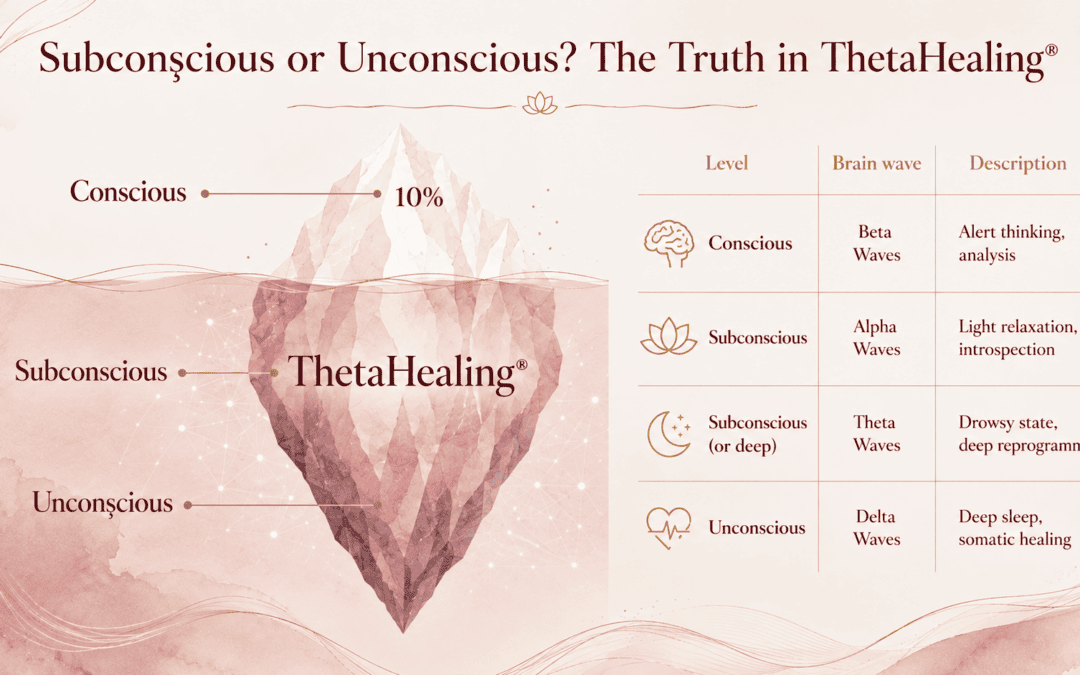
In the world of personal development, applied psychology, and holistic therapies, the terms “subconscious” and “unconscious” are frequently used interchangeably. However, from a scientific and structural perspective, there are distinct differences between these two concepts.
When discussing the ThetaHealing® technique, the choice of words is not merely a linguistic preference; it is an exact reflection of how our biology and mind operate. This educational guide clearly explains the grand debate between science and transformation, and why this specific method focuses entirely on the subconscious level.
The grand debate: the war of terms between science and transformation
In traditional academic psychology, classical schools often favor the rigid concept of the unconscious to describe everything that lies beyond our rational control.
Conversely, frontier practices and inner transformation modalities intentionally use the term subconscious. What is the truth behind this choice?
-
The unconscious is a biological protective barrier: It manages pure biological survival (such as your heartbeat, breathing, or reflexes) and stores deeply repressed traumas that the conscious mind is not ready to process without experiencing a major shock.
-
The subconscious is an accessible database: It operates as an open autopilot, controlling between 80% and 90% of our daily decisions and reactions. It stores habits, logical fears, and core beliefs absorbed during childhood. Although it runs in the background, it is not completely isolated: its programs can be brought to the surface, examined, and modified.
Therefore, ThetaHealing® seeks to empower us, reminding us that not everything is left to chance in the unconscious mind. Through this therapy and deep analysis, we gain the necessary tools to actively change our choices, transforming our autopilot into deliberate, conscious action.
The map of your mind and its direct link to brain waves
Every layer of your psyche functions in close connection with the electrical impulses of your brain. The frequency at which your brain vibrates determines which level of the mind you can actively access:
- Beta waves (The conscious mind): Represents only 5% to 10% of your daily mental activity. This is the frequency of logic, analysis, and awake alertness. As long as you are in beta waves, the mind acts as a critical filter that rejects new information or opposing core beliefs.
- Alpha waves (The bridge): These appear during states of light relaxation or daydreaming. It acts as the gateway connecting the conscious mind to the subconscious.
- Theta waves (The subconscious gateway): This frequency is specific to REM sleep (dreaming) or advanced meditation states. In the theta state, the logical guardians of the conscious mind relax, allowing direct, surgical access to the subconscious to rewrite limiting programs.
- Delta waves (The deep unconscious): The slowest frequency, specific to deep, dreamless sleep. It is closely associated with cellular regeneration and the body’s autonomous processes.
Why transformation only occurs in the subconscious
Changing a core belief (such as “money is hard to earn” or “I do not deserve success”) is nearly impossible through logical repetition alone while in a conscious state (beta waves), because your critical filter will simply reject it.
When the theta state is accessed, it triggers a state of accelerated neuroplasticity. The inner barriers dissolve, and old beliefs can be quickly identified through muscle testing and instantly replaced with new, constructive programs. Aligning your conscious desires with the software running in your subconscious mind is the only true path to a life lived in conscious harmony.
If you want to understand in depth how to navigate the map of your own mind and how this mental reprogramming protocol works in a practical format, explore the full details on